

In Defence of Command Economics
It's not a bad idea if done right and under the right circumstances.

Published 26/04/2025
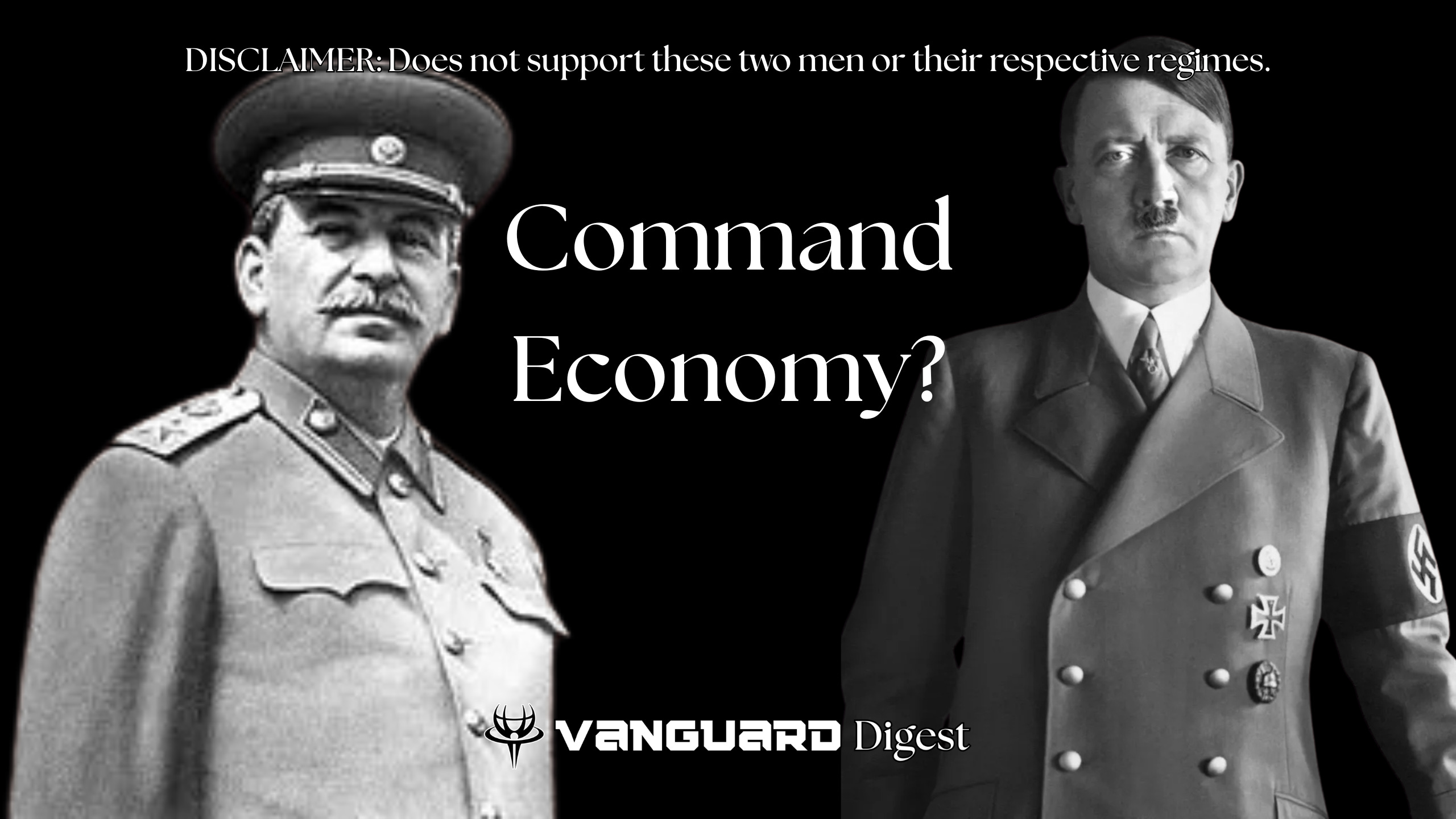
I must preface this Digest by making clear that I do not support Stalinism or Nazism as the thumbnail paired with the title might otherwise suggest. There is a disclaimer in the thumbnail, but I feel the need to point it out again here. The purpose of this Digest is simply to discuss command economics in theory, the pros and cons of a command economy, and the best way I think command economics could be implemented.
What is a Command Economy?
A command economy is, in basic terms, an economic model where the state has extensive centralised control over the economy, usually in the form of state ownership of the means of production or state control over the production, distribution and prices of products made by private companies, or a mixture of the two.
The most famous example of a command economy in its purest form was in the Soviet Union in the 20th century. In the Soviet Union, the state owned almost all the means of production, and centrally set quotas for production, set prices for products, set wages for workers, and allocated resources via a central planning body called Gosplan. The were trade unions in the Soviet Union, but they operated quite differently to the typical form of union seen in Western capitalist countries. Trade unions were extensions of the state, being operated by the All-Union Central Council of Trade Unions, which answered to the ruling Communist Party of the Soviet Union. Strikes were either rare or repressed by the state. A similar system existed in China until Deng’s reforms, and exists in various degrees in other “actually existing socialist” states in the world today, with the only pure command economy existing in the world today being in the Democratic People’s Republic of Korea aka North Korea.
Another form of command economy was established in the 20th century fascist regimes. I’m personally more familiar with the version seen in Mussolini’s Italy vs Nazi Germany, so I’ll use it as a framework here. Mussolini and other Italian Fascist thinkers invented the concept of “corporatism”, where the interests of the various classes in society, including the bourgeoisie, petty bourgeoisie and proletariat alike, would be subsumed to the interests of the Fascist state, with the state setting production quotas, product prices, workers’ wages, and allocating resources according to the needs of the state. The ownership of the means of production, however, was a mixture of private capitalist enterprises and state-owned enterprises, a key distinction from the completely state-owned nature of a pure command economy like that of the Soviet Union. But similar to the Soviet command economy, Fascist Italy also had dedicated Fascist Unions which were subservient to the state. Nazi Germany had a broadly similar arrangement, merely with the added element of racial hierarchy, meaning that only the upper echelons of the racial hierarchy had the full scope of rights within the state provided certain other conditions were met (like not being a communist, for instance).
I must stress here before moving onto the next section that command economy is a form of capitalist economy, not a socialist economy. I’ll elaborate in short what a socialist economy looks like at the end.
The Pros and Cons of a Command Economy
So now that I’ve explored what a command economy roughly is and the most infamous examples, I want to go over the pros and cons of a command economy and how some of the cons might be resolved.
The first benefit of a command economy is that it allows for rapid large-scale industrialisation in a place where industrialisation is lacking. This is how the Soviet Union was able to elevate itself from the agrarian feudalism of Tsarist Russia to become a superpower rivalling the United States in a matter of a few decades, as well as being the reason for its quick recovery following the trauma and destruction of the Nazi invasion during WW2. This same benefit for industrialisation also applies to militarisation, being how both the Soviet Union and Nazi Germany were able to heavily militarise at a startling speed. The reason for this benefit is because of the lack of delays commonly associated with markets, and the centrally planned allocation of capital, labour and materials to certain efforts.
Another benefit of a command economy is more long-term economic stability compared to a market economy, as state control avoids market phenomena such as periodic boom and bust cycles and inflation spikes, eliminating speculative bubbles and being uniquely able to provide the promise of full employment, which a market economy is incapable of due to the law of the reserve army of labour.
A third benefit is that the state can opt to prioritise public welfare over the profit motive in a command economy, investing in public infrastructure and subsidising and guaranteeing essential services like housing, healthcare and education. The final benefit is the ability for a command economy to be aligned with national interests, avoiding the fragmented interests of a market economy. This was in particular why the command economies of the Soviet Union and the fascist regimes were so successful at meeting certain national goals (whether those goals were good or moral is another question).
Now onto the cons. The first drawback to a command economy is the large amount of bureaucracy necessary to keep the system running smoothly, which can lead to inefficiencies including the misallocation of resources, due to the lack of market feedback which can produce inaccurate data. Rigid targets can also lead to problems. In the modern day, the issue of inaccurate data could be resolved using widespread digital systems to track supply and demand, an option not available to historical command economies. Though as I’ll get to in the last section, such measures can only save a command economy for so long.
Another drawback emerging from state centralisation of the economy and monopoly over the means of production, is the lack or stagnation of innovation. This is a similar problem to what emerges when a market economy progresses to consolidate wealth and the means of production in the hands of a few monopolies or non-competing industrial cartels of a handful of companies. This is worsened by state monopolisation, as the state is not bound to a profit motive, discouraging risk-taking and creativity. This issue could be solved with the introduction of incentive structures to encourage innovation, or the introduction of some market mechanisms in a mixed economy.
A third drawback is the emphasis on heavy industry at the expense of light industry. Heavy industry, meaning immediate societal needs like public infrastructure, military, and raw material production, has often been prioritised in resource allocation at the expense of light industry, which means primarily consumer goods. This led to a lack of variety in consumer goods in countries that had a command economy. This issue can be resolved using a mixed economy, with heavy industry falling under a command economy and light industry remaining under market mechanisms.
The last major drawback of a command economy is the biggest of all, which is that a command economy inevitably stagnates and begins to cripple under the weight of all the bureaucracy it requires to function, the inefficiencies and rigidity of the system piling up to a crisis point. This is what happened to the Soviet Union in the 1980s, leaving only two options when all was said and done; liberalisation or socialisation. With the dissolution of the Soviet Union in 1991, the Soviet leadership made the decision to do the former, giving way to a market economy and the Russian Federation as we know it today.
There is a lesser drawback to a command economy in the form of authoritarian tendencies, like using political persecution to enforce plans and suppress strike action on the part of workers. But this, as I will propose, can be solved via a command economy being implemented in a multi-party democracy where only one or some of the parties support the command economy. Though this proposal also introduces a problem of its own which I’ll get to.
A Potential Use for Command Economy in the Australian Context
What I now want to discuss is a potential blueprint for a command economy in Australia. First things first, I’ll set out some key foundations.
Firstly, this command economy would apply solely to heavy industry, so for the production of raw materials, construction of key infrastructure, and building up of the military, strictly for the purpose of defence in this scenario. This means Australia in this scenario would have a mixed economy, with light industry remaining under free market laws.
Secondly, this command economy would be under primarily or entirely state ownership, with existing heavy industry in Australia being either nationalised with compensation, or the corporations running said heavy industry being subsumed to the command economy.
Thirdly, Australia would remain a multi-party democracy in this scenario, with only one party being in favour of the command economy (wink wink) and the rest being against it. This means the party in question would remain accountable to the Australian people via elections. One pitfall of this approach, which is the reason the most successful command economies have been under one-party state dictatorships, is that a command economy is a long-term pursuit, taking longer than 1-2 terms of 3 years each, and therefore rendering the pursuit compromised if another party is elected to government which opts to stop the command economy and privatise the gains made up to that point. This does present some issues which make the prospect of a successful command economy in a multi-party democracy a highly volatile and unlikely one, albeit not impossible in theory.
Lastly, this command economy would be intended only as a temporary measure to achieve certain goals. Let’s say those goals are as follows:
Industrial and economic autarky.
A unique national plan for Net Zero emissions distinct from that of the Paris Climate Accords.
Growth of military capability to superpower status, though solely for the purpose of national self-defence, not imperialism or war.
After these goals are achieved, the command economy would be phased out, either via liberalisation or socialisation. Liberalisation simply means privatising all the industry and reverting it to a market economy. Socialisation is different, and involves transitioning from a top-down command economy to a bottom-up democratically planned economy. This requires prefiguration and revolution, building the new society in the shell of the old. It will not be done from above. It cannot be done from above, only from below. I’ll elaborate on the details of a democratically planned economy in a future Digest, so for now, thanks for reading.